


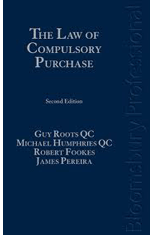
The Law of Compulsory Purchase
Publisher: Bloomsbury Professional
Editors: Guy Roots QC, Michael Humphries QC, Robert Fookes & James Pereira
Price: £138.00
Edition: 2nd Edition (July 2011)
ISBN: 978-1-84766-746-5
Buy from Bloomsbury Professional: Click Here

 Being spread across several statutes means,
like the editors point out, compulsory
purchase law and compensation appears a daunting area of law. These
features do, however, make this an extremely interesting area of law
with numerous issues to be resolved. To overcome these issues, and make
sense of the law, a clear and authoritative explanation of the
principles, and their application, is fundamental. Fortunately, The
Law of Compulsory Purchase provides exactly this.
Being spread across several statutes means,
like the editors point out, compulsory
purchase law and compensation appears a daunting area of law. These
features do, however, make this an extremely interesting area of law
with numerous issues to be resolved. To overcome these issues, and make
sense of the law, a clear and authoritative explanation of the
principles, and their application, is fundamental. Fortunately, The
Law of Compulsory Purchase provides exactly this.
Written by a team of leading compulsory purchase barristers from Francis Taylor Building, who also co-author Bloomsbury’s Compulsory Purchase and Compensation Service, The Law of Compulsory Purchase is broken down into eight ‘divisions’: introduction; powers of compulsory purchase; compulsory purchase orders and procedure; implementation of compulsory purchase; compensation for compulsory purchase; compensation where no land is taken; compensation for decisions, controls and works; and determination and recovery of compensation. By breaking the material up in this way, the authors ensure the reader is logically led through the principles.
Because The Law of Compulsory Purchase is essentially the loose-leaf without the legislation and precedents, it takes some time to become familiar with its ‘division’ approach (which works well in a loose-leaf format). However, once this minor issue is overcome, the relevant material can be quickly located. Impressively, the authors explain the principles in a straightforward and engaging way meaning complex issues are quickly understood. In particular, the division on compensation for compulsory purchase is excellent and explains the likely approach of the Upper Tribunal (Lands Chambers). It also superbly tackles the latest case-law including Pattle, Abbey, Thomas Newall and Urban Edge.
For anyone practising in or advising on this complex but interesting area of law, The Law of Compulsory Purchase is a wonderful guide to the relevant principles and their application. Its content is pretty similar to its sister loose-leaf publication meaning it is authoritative and comprehensive whilst being excellent value for money. It also, usefully, refers to reader to relevant precedents in its sister publication. The chapter on the Upper Tribunal (Lands Chamber) (which replaced the Lands Tribunal) has been completely re-written to provide an engaging and authoritative cover of the new regime. It could, however, benefit from a greater discussion on costs and sealed offers (which are significant in practice). It is, in spite of this, a text which, when advising claimants and acquiring authorities, will remain close to hand.
Reviewed on 1 January 2012
© Student Law Journal, 2001 - All Rights Reserved
Home | News | Academic Articles | Practitioner Articles | Editorial Board | Article Submission | Contact | Links | Book Reviews