


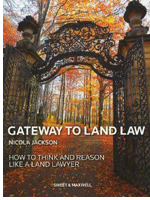
Gateway to Land Law
Publisher: Sweet & Maxwell
Author: Nicola Jackson
Price: £29.95
Edition: 1st Edition (June 2012)
ISBN: 978-0-414-04487-6
Buy from Sweet & Maxwell: Click Here

 Land
law is (and continues to be) a subject which many students struggle
with. The reasons for this are always hotly debated but, in my
view, the better explanation is that students are quickly confused by
its perceived complex mix of common law and statutory principles.
This problem is also combined with the fact that most students tackling
land law for the first time have not had much (or any) practical experience
of land law. To try and overcome these
problems, Gateway to Land Law aims to (a) give a clear exposure
and analysis of the rules of land law and (b) present a clear method of
critical thinking. These are clearly ambitious aims and ones which
Gateway to Land Law largely achieves.
Land
law is (and continues to be) a subject which many students struggle
with. The reasons for this are always hotly debated but, in my
view, the better explanation is that students are quickly confused by
its perceived complex mix of common law and statutory principles.
This problem is also combined with the fact that most students tackling
land law for the first time have not had much (or any) practical experience
of land law. To try and overcome these
problems, Gateway to Land Law aims to (a) give a clear exposure
and analysis of the rules of land law and (b) present a clear method of
critical thinking. These are clearly ambitious aims and ones which
Gateway to Land Law largely achieves.
Written by Nicola Jackson, an experienced and highly regarded academic, Gateway to Land Law is split into thirteen chapters which cover the most important principles of land law: the building blocks of land law; land ownership in English law; formal and informal ownership; principles of co-ownership; the statutory regulation of co-ownership: trusts of land; land transfer law (1): general principles; land transfer law (2): the 1925 legislation; land transfer law (3): the system of registration of title to land; the leasehold estate; leasehold covenants; easements; freehold covenants; and mortgages. Chapter 1 of Gateway to Land Law is particularly important as it explains Jackson's thinking behind her approach and sets the scene for the following chapters.
Jackson's approach is to set out a number of 'building blocks'. These are, in turn, used as a platform to critically challenge principles or procedures. This is a good idea and, as Jackson makes clear, these building blocks should be constantly revised and refined as the reader becomes more familiar with the topic. What I found less useful was the 'student/lecturer discussions'. While they explained the points which may be discussed in a seminar, and gave some examples of how the building blocks can be used to encourage critical thinking, they did not (to my mind) add much to the discussion. The law was, however, clearly and impressively explained throughout the text: this is no mean feat for any land law text.
Jackson's aims to (a) give a clear exposure and analysis of the rules of land law and (b) present a clear method of critical thinking are ambitious. It is therefore pleasing that Gateway to Land Law largely achieves it. Jackson's writing style is both clear and engaging; her approach also stimulates the readers thinking and analysis. For example, after reading the part on tacking and further advances, I was encouraged to undertake my own research. This perhaps sums up Jackson's aim, and the quality of the Gateway to Land Law, in a nutshell. I therefore have no doubt that this will soon become a key text for anyone studying or interested in land law.
Reviewed on 21 December 2012
© Student Law Journal, 2001 - All Rights Reserved
Home | News | Academic Articles | Practitioner Articles | Editorial Board | Article Submission | Contact | Links | Book Reviews | Legal Information