


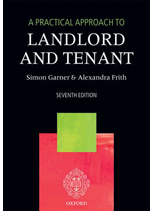
A Practical Approach to Landlord and Tenant
Publisher: Oxford University Press
Authors: Simon Garner & Alexandra Frith
Price: £49.99
Edition: 7th Edition (February 2013)
ISBN: 978-0-19-966251-7
Buy from OUP: Click Here

 The
last time that I reviewed A Practical Approach to Landlord and Tenant
Law was back in 2005 when it was only in its fourth edition.
That edition had to tackle the substantial amount of change resulting
from the
introduction of the Regulatory Reform (Business Tenancies) (England and
Wales) Order 2003 and the Commonhold and Leasehold Reform Act 2002.
It expertly did so. Since then, there have continued to be further
developments in landlord and tenant law. The approach
of this text has
not, however, changed. A Practical
Approach to Landlord and Tenant Law continues to do exactly what it says
it will: it
provides a practical guide to the landlord and tenant issues that any
property or property litigation lawyer will commonly face.
The
last time that I reviewed A Practical Approach to Landlord and Tenant
Law was back in 2005 when it was only in its fourth edition.
That edition had to tackle the substantial amount of change resulting
from the
introduction of the Regulatory Reform (Business Tenancies) (England and
Wales) Order 2003 and the Commonhold and Leasehold Reform Act 2002.
It expertly did so. Since then, there have continued to be further
developments in landlord and tenant law. The approach
of this text has
not, however, changed. A Practical
Approach to Landlord and Tenant Law continues to do exactly what it says
it will: it
provides a practical guide to the landlord and tenant issues that any
property or property litigation lawyer will commonly face.
Written by two experienced practitioners, A Practical Approach to Landlord and Tenant Law is split into two parts: the common law and the statutory codes. The first part includes chapters on: the basics; the distinction between a lease and a license; creating a tenancy; introduction to obligations in leases; implied obligations; express obligations; repair - contractual obligations; repair - common law and statutory duties; assignment and subletting - continuing obligations; termination of tenancies: an overview - the common law rules; and forfeiture. The second part includes chapters on: the Rent Act 1977; the Housing Act 1985; the Housing Act 1988; commonhold; business tenancies; agricultural holdings; and farm business tenancies.
A Practical Approach to Landlord and Tenant Law aims to provide a comprehensive and systemic guide to the principles and practice of landlord and tenant law. It achieves this aim with considerable ease by explaining the law in a practical and accessible way. It has an excellent layout and make super use of short and manageable sections to ensure a point is easily understood. It also has some first-rate flow charts (one of the best being figure 12.1 which is a flow chart to help practitioners decide which statutory code applies). It also includes some precedents but it would be useful, for future editions, to (i) include more (including, perhaps, precedent Section 25 or 26 Notices under the Landlord and Tenant Act 1954) and (ii) make them stand out from the text so they can be more easily found.
It is some achievement to pack into one manageable sized text a practical guide to a complicated topic like landlord and tenant law but Garner and Frith have (once again) expertly managed it with A Practical Approach to Landlord and Tenant Law. Landlord and tenant law is often packed with a number of technical issues, not least the drafting and service of statutory notices for residential, business and agricultural tenancies (and challenges to such notices often occupy the courts). The practical focus of this text means that the risk of such technical challenges should be reduced. Its price, at less than £50, is also excellent value for money for such a practical and accessible guide to a difficult area of law.
Reviewed on 23 August 2013
© Student Law Journal, 2001 - All Rights Reserved
Home | News | Academic Articles | Practitioner Articles | Editorial Board | Article Submission | Contact | Links | Book Reviews | Legal Information