


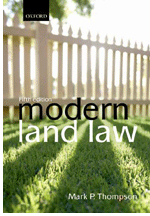
Modern Land Law
Publisher: Oxford University Press
Author: Mark P. Thompson
Price: £31.99
Edition: 5th Edition (June 2012)
ISBN: 978-0-19-964137-6
Buy from OUP: Click Here

 This
fifth edition of Modern Land Law has been thoroughly revised and
updated to include the latest changes to the law. This includes
extended coverage of the impact of human rights (including consideration
of the Supreme Court's decision in Manchester City Council v Pinnock
[2010] UKSC 45), coverage of the developments concerning estoppel
(including the House of Lords' decision in Thorner v Major & Others
[2009] UKHL 18) and coverage of the Supreme Court's decision in
Berrisford v Mexfield Housing Co-operative Limited [2011] UKSC 52 on
the certainty of lease. These revisions have been seamlessly
incorporated into the last edition.
This
fifth edition of Modern Land Law has been thoroughly revised and
updated to include the latest changes to the law. This includes
extended coverage of the impact of human rights (including consideration
of the Supreme Court's decision in Manchester City Council v Pinnock
[2010] UKSC 45), coverage of the developments concerning estoppel
(including the House of Lords' decision in Thorner v Major & Others
[2009] UKHL 18) and coverage of the Supreme Court's decision in
Berrisford v Mexfield Housing Co-operative Limited [2011] UKSC 52 on
the certainty of lease. These revisions have been seamlessly
incorporated into the last edition.
Modern Land Law has an uncomplicated approach to its layout: the material is logically and impressively arranged. It has fifteen chapters: the scope of the subject; tenure and estates; law, equity and human rights; the 1925 legislation; registration of title; the transfer of freehold land; possessory title; consecutive and concurrent interests in land; co-ownership 1: acquisition of interests in the home; co-ownership 2: the legal framework of co-ownership; leasehold estates; mortgages; easements; covenants between freeholders; and licences and estoppel.
It is often said by anyone studying land law for the first time that understanding this area of law is one of the most challenging parts of an undergraduate law degree. This is probably because of (a) the vast amount of material and (b) the mix of sources for that material (including statutory provisions, case-law and equitable principles). Modern Land Law tries to help the reader overcome these issues by demystifying the complex weave of matters while, at the same time, keeping a high level of detail (which is vital for students wanting to move onto the next step of understanding). The material is also clearly structured; this allows the reader to quickly follow the key building blocks and really understand the topic.
Modern Land Law clearly and concisely explains the law and considers, from time to time, whether some of the archaic legal principles (like the clog on the equity of redemption) have any place in modern land law. The key feature of this text is its ability to avoid complicated jargon or dense text. The diagrams are also very helpful and really help explain issues like severance; the text may, however, benefit from some summary boxes on key topics to boil down the key principles for students struggling to understand this complex area of law. If you are looking for an accessible account of property law, then you should seriously consider buying Mark Thompson's Modern Land Law.
Reviewed on 5 May 2014
© Student Law Journal, 2001 - . All Rights Reserved
Home | News | Academic Articles | Practitioner Articles | Editorial Board | Article Submission | Contact | Links | Book Reviews | Legal Information