


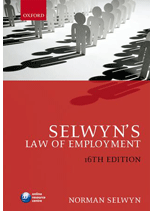
Selwyn's Law of Employment
Publisher: Oxford University Press
Author: Norman Selwyn
Price: £32.99
Edition: 16th Edition (September 2010)
ISBN: 978-0-19-957873-3
Buy from OUP: Click Here

 Given
the extensive coverage of employment law in universities at
undergraduate and postgraduate level, it is important for students to
choose a text that suits them. There are many texts on the market
but the recent implementation of the Equality Act 2010 requires a
radical update on the current and future position. Selwyn’s Law
of Employment, written by the late Norman Selwyn, aims to provide
such an update for students, whilst also covering the essential aspects
of employment law.
Given
the extensive coverage of employment law in universities at
undergraduate and postgraduate level, it is important for students to
choose a text that suits them. There are many texts on the market
but the recent implementation of the Equality Act 2010 requires a
radical update on the current and future position. Selwyn’s Law
of Employment, written by the late Norman Selwyn, aims to provide
such an update for students, whilst also covering the essential aspects
of employment law.
Now in its sixteenth edition (and, unfortunately, the last edition to be authored by Norman Selwyn), Selwyn’s Law of Employment once again comes with Oxford University Press’ useful online resource centre. This, like previous editions, provides practical updates to the law since the text's publication. At the time of writing, there is only one update which demonstrates that Selwyn has aptly captured the most recent developments within the original text.
Written by a former university lecturer and barrister with over forty years' experience, Selwyn’s Law of Employment is divided into twenty-three chapters. It covers all areas of employment law from the basics to the formation of a contract of employment to trade unions and industrial action. It is written clearly and makes ample references to the relevant sections of Acts of Parliaments: this is a useful feature for articles. Selwyn’s Law of Employment is easy to use as the contents and index are well laid out; they do not simply redirect you to another page. It is predominantly a one stop shop for undergraduates but the newer sections dealing with equality could refer to previous case law more extensively
For students looking for a ‘catch all’ text with comprehensive detail in most areas, Selwyn’s Law of Employment is the best. The footnotes are clear and concise, leaving the substantive content to the main body of the text. Norman Selwyn’s experience is evident through-out the text as he highlights the theoretical issues with potential future implications. He must also take credit for his ability to combine complex legal information with an accessible writing style. Future editions may, however, be improved by adding ‘thinking points’ or summary questions so that it is more interactive with the reader.
Reviewed on 5 April 2011 by Gabrielle Church
© Student Law Journal, 2001 - All Rights Reserved
Home | News | Academic Articles | Practitioner Articles | Editorial Board | Article Submission | Contact | Links | Book Reviews