


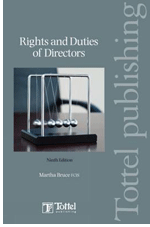
Rights and Duties of Directors
Publisher: Bloomsbury Professional
Author: Martha Bruce
Price: £95.00
Edition: 9th Edition (February 2009)
ISBN: 978-1-84592-458-4
Buy from Bloomsbury Professional: Click Here

 For
many directors, being aware of their rights and duties is a key step
before appointment. Unfortunately, many directors largely rely
on their own knowledge which may (or may not) be enough. Being a
director is, however, a big responsibility and not one to be taken
lightly. Before accepting a directorship, any prospective director could do no
worse than leaf through the pages of Martha Bruce's Rights and Duties
of Directors.
For
many directors, being aware of their rights and duties is a key step
before appointment. Unfortunately, many directors largely rely
on their own knowledge which may (or may not) be enough. Being a
director is, however, a big responsibility and not one to be taken
lightly. Before accepting a directorship, any prospective director could do no
worse than leaf through the pages of Martha Bruce's Rights and Duties
of Directors.
Rights and Duties of Directors is split into fourteen chapters: the nature of office of director; directors, the board and the company secretary; directors' rights; statutory statement of directors' general duties; breach of duty by a director; statutory duties of directors; accounting and financial responsibilities of directors; directors' duties an the shareholders; directors' duties and the public company; directors and corporate governance; directors' duties and employment issues; directors' duties and the environment; duties and the customer; and directors, creditors and insolvency. It also has an impressive number of appendices: forty-two in total including some precedents.
Bruce, being a qualified chartered secretary and an experienced practitioner, is well-placed to write a practical guide for directors. Its written style is direct and accessible meaning it provides a clear and coherent account of the law. Readers should, however, be aware of the text's limitations. Firstly, it is not (nor does it pretend to be) a full and comprehensive account of the law. Secondly, where the author steps outside of pure company law issues she does trip up a little. For example, when discussing consumer credit, the text suggests companies need to comply with the Consumer Credit (Agreements) (Amendment) Regulations 2004: this was, however, only an amending regulation and agreements should comply with (at present) the Consumer Credit (Agreements) Regulations 1983. These issues do not, however, detract from the text: it is simply a minor health warning.
For any director (experienced or inexperienced), this is a key text they should not be without. It is well written and its beauty is its simplicity: complex issues are written in small and manageable sections meaning they can be quickly read and understood. Lawyers will also find this text invaluable as an introductory summary or starting point for further research. It is well cross-referenced to the statutory provisions, includes some excellent summaries and check-lists and, importantly, the appendices are very useful (particularly the precedent notices and board minutes). It is also well priced for both companies and their advisors meaning lawyers, at the very least, should have a copy in the library.
Reviewed on 11 April 2010
© Student Law Journal, 2001 - All Rights Reserved
Home | News | Academic Articles | Practitioner Articles | Editorial Board | Article Submission | Contact | Links | Book Reviews